

Is Svartruna worth it for black metal guitarists?
Yes—SVARTRUNA is worth it for black metal guitarists who want an amp sim built specifically for black metal and death metal, with nine captured gain stages and three cabinets. The caveat: that focused design is a reason to choose it for extreme metal, not evidence that it should replace every guitar sound in your DAW.
- Is Svartruna worth it? Yes for black metal producers seeking a genre-focused amp sim rather than a general-purpose collection.
- Oracle Sound SVARTRUNA includes nine captured gain stages and three cabinets for black metal and death metal guitar tones.
- Choose SVARTRUNA for its stated production focus; choose SLAMP when slam and brutal death metal are the priority.
- Judge tremolo-picked definition against bass and drums, not just the size of the soloed guitar sound.
Is SVARTRUNA worth it for black metal guitarists?
Oracle Sound SVARTRUNA is best for black metal guitarists who want an extreme-metal amp simulator with captured gain-stage and cabinet choices. Its stated design covers black metal and death metal, making it a direct fit for that production brief in 2026.
The useful comparison is not which plugin sounds heaviest in isolation. It is which product starts closest to the sound your arrangement needs.
| Amp sim | Best for | Stated design | Main advantage for that brief | Trade-off |
|---|---|---|---|---|
| SVARTRUNA | Black metal and death metal | Extreme-metal amp simulator with nine captured gain stages and three cabinets | Its stated genre focus matches black metal production | A focused extreme-metal brief does not establish broad clean or low-gain coverage |
| SLAMP | Slam, brutal death metal and deathcore | Dense, weight-focused amp sim with SOLID STATE and TUBE choices | Its stated purpose matches heavy slam-oriented guitar parts | That emphasis is a different starting point from black metal |
| TYRANT | Players choosing between high-gain voices | SATN and TRSH voices, with BOOST available on both | Offers a direct choice between two named amp voices | Voice selection is a different decision from SVARTRUNA’s captured gain-stage approach |
These are differences in product design, not a measured sound-quality ranking. Select the closest production brief, then judge the guitar inside your own arrangement.
Why this matters
Black metal guitar needs more than saturation. Tremolo-picked notes, sustained chords and layered harmonies have to coexist with cymbals, bass and dense drums; distortion alone does not solve that balance.
Oracle Sound’s amp sims address different heavy-guitar briefs. SVARTRUNA’s relevance comes from its explicit black metal and death metal focus, rather than a claim that every extreme-metal production needs the same tone.
For a 2026 recording project, make the decision around the work you actually do. If black metal dominates your sessions, a focused amp sim has a clear role. If your existing setup already produces the required sound, another plugin needs to solve a specific problem before it earns space in the session.
SVARTRUNA’s nine captured gain stages: what to evaluate
Nine captured gain stages give you choices to audition. They are not a reason to start with the most saturated setting, and the stage count alone does not prove better definition or realism.
Use the same recorded DI passage when comparing stages. Include tremolo picking, a sustained chord and a stop so you can hear note separation, harmonic density and the end of the phrase without changing performances.
Choose the gain stage that keeps the riff readable at the required intensity. If adjacent notes merge into a continuous wash before the arrangement calls for it, audition a less saturated option rather than immediately adding corrective EQ.
For raw black metal, roughness can be intentional. Keep the abrasive texture you want, but distinguish that texture from a riff losing its harmonic movement. Those are different production decisions.
Practical gain-stage audition
- Keep the DI, cabinet choice and downstream processing unchanged.
- Compare output levels before choosing a favourite.
- Listen for the movement between chord shapes, not just the attack.
- Check whether muted transitions remain distinct from sustained notes.
- Make the final choice with bass and drums playing.
Treat this as your evaluation method in 2026, not a preset recipe. Pickup output, playing dynamics and the recorded performance all affect what reaches the amp sim.
SVARTRUNA’s three cabinets: choose the texture before EQ
Three cabinets provide a defined set of cabinet choices. Audition those choices before building a corrective EQ chain around the first sound you load.
Cabinet filtering changes the tonal balance after distortion. That makes the cabinet decision relevant to both upper-frequency aggression and how much low-mid weight the guitar occupies beside bass.
Hold the gain-stage choice steady while comparing cabinets. Listen to the top string during tremolo picking, then listen to a low chord under the full drum part. Keep the cabinet that supports both jobs without making either one unpleasant.
Do not choose a cabinet solely because it sounds larger when soloed. A broad low end can be attractive alone while competing with the bass once the arrangement starts.
After choosing the cabinet, use a DAW EQ for a specific correction. Reduce unwanted low-frequency build-up or an abrasive band only when you can identify the problem in context; avoid shaping the track around an assumed black metal EQ curve.
How should you set up SVARTRUNA in a DAW?
Start with a clean DI and a simple monitoring path. Preserve the unprocessed recording so you can change the amp sound without replaying the part.
Use this basic sequence: Clean DI, Amp sim, Cabinet stage, DAW EQ, Guitar bus. The cabinet stage belongs after the amp processing; avoid adding another cabinet processor automatically when the chosen path already includes cabinet filtering.
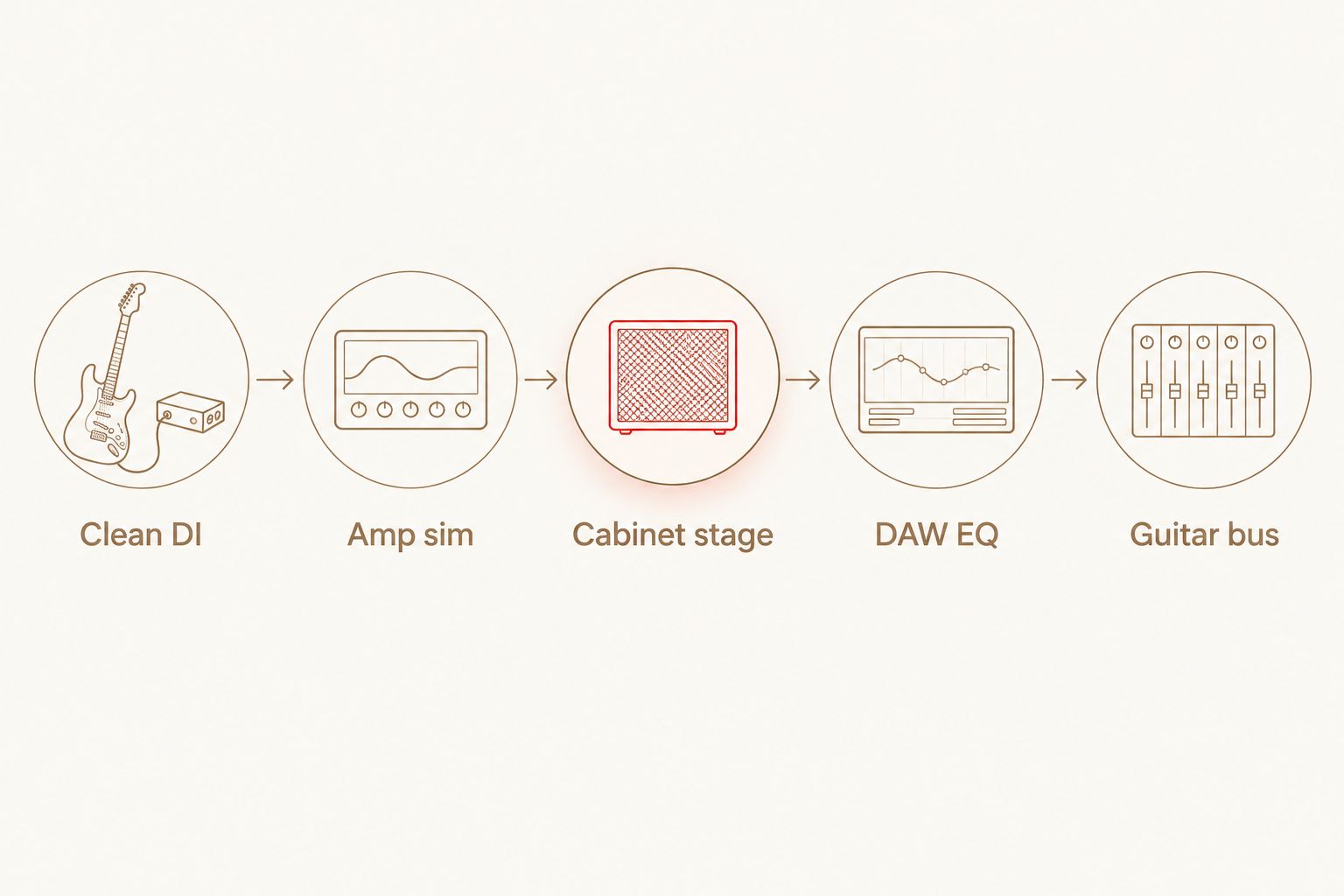
The chain is deliberately short. Add processing only when it fixes an audible issue or creates an intentional effect, rather than treating a long insert list as part of the genre.
- Record an unclipped DI. Watch the interface input while playing the hardest section. Distortion in the amp sim is intentional; clipping the recording input is a separate event.
- Audition the captured gain stages. Use the same passage and keep cabinet selection fixed. Listen for pick definition and sustained chord movement.
- Compare the cabinets. Keep the selected gain stage unchanged. Judge each cabinet with the actual bass and drum parts.
- Correct a defined problem. Use DAW EQ only after identifying unwanted rumble, build-up or harshness. Bypass the EQ to confirm the correction helps.
- Balance the guitars in context. Set guitar level against the arrangement before adding further saturation or widening.
For your 2026 session template, save the DI routing separately from the tone choice. That keeps the recording path consistent while letting the production sound change between songs.
What should you listen for in black metal riffs?
Tremolo-picked definition
Play a phrase with changing chord shapes rather than a repeated single note. The test is whether the harmonic movement remains audible when the drums enter.
If the passage blurs, compare less saturation before reaching for a brighter EQ setting. More treble does not restore note distinctions that the distorted signal no longer makes clear.
Sustained chord texture
Hold the chord through its decay. Listen for whether the upper notes remain part of the harmony or become an undifferentiated layer of noise.
Neither outcome is automatically wrong for black metal. Choose deliberately: a wall of texture suits some passages, while a harmonised riff needs the underlying intervals to carry through.
Stops and exposed transitions
Check the gaps between phrases. Noise, string movement and effect tails become easier to hear when the arrangement stops.
If you use a gate elsewhere in the DAW chain, set it against the quietest intended sustain. A gate that removes the end of the note changes the performance, not just the noise floor.
Layered rhythm guitars
Record separate performances when you want double-tracked rhythms. Duplicating the same audio does not create a second performance.
Evaluate the combined guitars before adding extra layers. If the core rhythm pair masks the riff, adding more tracks increases the material competing for the same space.
Why SVARTRUNA’s value varies between guitarists
SVARTRUNA’s feature list stays the same, but its usefulness depends on the production job. These are the main decision factors for a 2026 black metal project:
- Genre focus. Its stated black metal and death metal purpose is directly relevant when those styles dominate your work.
- Gain-stage needs. Nine captured gain stages matter when you want to compare different degrees of saturation within this amp-sim approach.
- Cabinet workflow. Three cabinets give you choices to audition before reaching for separate cabinet processing.
- Existing tools. An amp sim that already delivers the required tone reduces the reason to add another one.
- Range of sessions. A narrow extreme-metal brief is easier to match to SVARTRUNA than a workload spanning unrelated guitar styles.
- Arrangement demands. Fast harmonised riffs and sustained texture parts require different listening decisions, even within the same song.
Buy for a production need, not for the number of choices. A useful addition either gives you a required sound or makes a repeated recording task more direct.
Is SVARTRUNA better than SLAMP for black metal?
SVARTRUNA is the more directly matched choice for black metal by stated design. SLAMP is aimed at slam, brutal death metal and deathcore, so choose SLAMP when that dense, weight-focused brief describes the guitars you need.
That is a category-fit verdict, not a claim that SLAMP cannot appear on a black metal recording. Genre labels help narrow the starting point; the recorded arrangement determines the final choice.
Can SVARTRUNA cover death metal as well?
SVARTRUNA is explicitly designed for death metal as well as black metal. That makes it relevant to projects moving between those styles without requiring a different product category.
Use a death metal passage to evaluate the same essentials: chord definition, muted transitions and the relationship between guitars, bass and kick. Do not assume the gain-stage choice that suits a sustained black metal texture also suits every tightly stopped riff.
Is SVARTRUNA worth adding if your current amp sim works?
SVARTRUNA is worth adding when its extreme-metal focus fills a specific gap in your setup. Keep your current amp sim if it already delivers the required guitar sound and you have no clear recording problem to solve.
Name the gap before changing tools. Whether you need a different distortion texture or a more suitable cabinet starting point, compare that exact requirement rather than replacing a working chain wholesale.
FAQ
Is Svartruna worth it for black metal guitarists?
Yes—SVARTRUNA is worth considering for black metal guitarists who want an amp simulator designed for black metal and death metal. Its stated features include nine captured gain stages and three cabinets.
What is Oracle Sound SVARTRUNA best for?
Oracle Sound SVARTRUNA is best for guitarists and producers seeking an extreme-metal amp sim focused on black metal and death metal. Choose it for that production brief rather than assuming it covers every guitar style.
How many captured gain stages does SVARTRUNA have?
SVARTRUNA has nine captured gain stages. Compare them using the same DI passage and matched listening levels so performance changes do not influence the decision.
How many cabinets does SVARTRUNA include?
SVARTRUNA includes three cabinets. Audition the cabinet choices against bass and drums before adding corrective EQ.
Is SVARTRUNA better than SLAMP for black metal?
SVARTRUNA is more directly matched to black metal by its stated design. SLAMP is designed around slam, brutal death metal and deathcore, making it a different production starting point.
Should I use maximum gain for tremolo-picked black metal guitar?
No—choose enough saturation for the required texture while keeping the harmonic movement audible. Compare gain stages with the full arrangement rather than judging only the soloed guitar.
Do I need to replace my current amp sim with SVARTRUNA?
No—keep your current amp sim if it already produces the required sound. Add SVARTRUNA when its black metal and death metal focus addresses a specific gap in your recording setup.
One last thing
Before committing to a guitar tone, turn the guitar down in the mix. If the riff only makes sense when it overwhelms the bass and drums, revisit the performance, saturation or cabinet choice before turning it back up.
Record-ready guitar tones support the song at a workable balance. For black metal, that can still mean abrasive, noisy and deliberately rough—the important distinction is whether you chose the texture or lost the riff inside it.


